검색









도서 표지 크게보기

선물하기

- - 휴대폰번호, 이메일로 선물을 전송해보세요.
- - 배송주소는 선물을 받는 분이 직접 입력합니다.
- - 쇼핑카트에서도 선물하기가 가능합니다. 추천! 모바일 선물 더보기
-
수량
-
배송비무료배송
-
출고예정일2026년 11월 26일(목) (목)
-
판매가35,000원 31,500원 [10%할인]
-
적립금
- 1,750원 적립[5%P]

-
결제혜택


-
수량
-
배송비
무료배송
-
출고예정일2026년 11월 26일(목)
※출고 예정일은 도서 재고상황에 따라 변동 될 수 있습니다.
Department of Infectious Diseases Asan Medical Center Seoul, South Korea
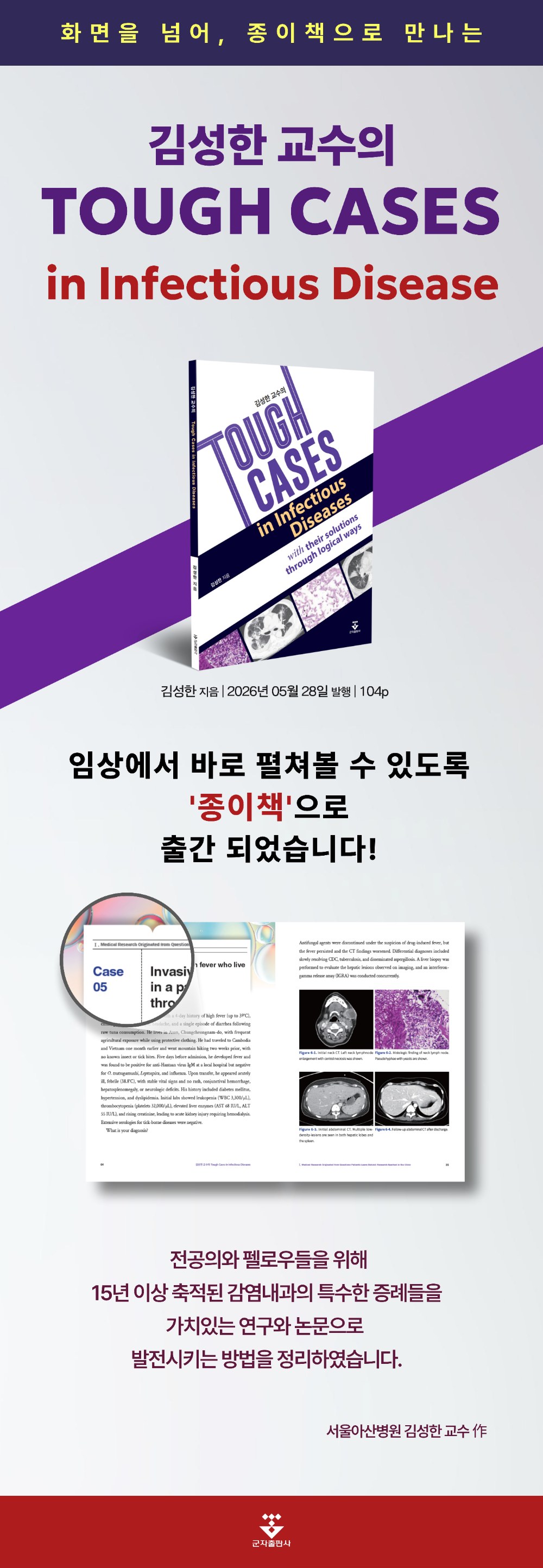
[이 책은]
For more than twenty years at the bedside, my research has begun where patient care leaves questions unanswered. Each case arrives with its own quiet provocations: Why did we miss the earliest moment to diagnose? Could a different pathway have led
to a safer, faster recovery? Over time, I came to see that research is not separate from the clinic—it is the disciplined pursuit of answers to the questions our patients give us.
This book grew out of fifteen-plus years of teaching residents and fellows how to turn those questions into studies worth doing—and papers worth writing. In morning reports, on rounds, and especially in our weekly Friday case conferences, we practiced
a simple habit: start from the case, ask many precise questions, then choose one that is answerable, impactful, and methodologically sound. Repeated often enough, that habit becomes a craft.
Part I is a practical invitation to that craft. It shows how a single case can branch into multiple researchable questions—diagnostic, therapeutic, prognostic, systems level—and how to narrow from curiosity to a study design that fits your time and data. The goal is motivation with traction: to help young physicians take a first step into research that improves care, not just careers.
Part II collects selected infectious-disease cases from more than fifteen years of those Friday conferences, refined into a quiz–answer–review format. The cases were chosen not for their drama but for their teachable pivots: a misweighted pretest probability, an overlooked exposure, a culture that finally clarified the picture, a treatment decision that proved decisive. Read them as you would see patients—one by one—and let each answer sharpen your clinical judgment and suggest your next study.
PART I. Medical Research Originating from Questions Patients Leave Behind: Research Sparked in the Clinic
Case 01. Unmasking the diagnostic challenge: Distinguishing IPA from TB in immunocompromised patients
Case 02. Revealing the risk of saving lives: Nosocomial transmission of SFTS in healthcare workers
Case 03. A diagnostic dilemma: Differentiating invasive aspergillosis from mucormycosis in immunocompromised patients ·
Case 04. A silent transmission: Fatal disseminated scedosporiosis in a transplant recipient from a nearly-drowned donor
Case 05. Invasive pulmonary aspergillosis in a patient with severe febrile thrombocytopenic syndrome
Case 06. Persistent fever despite of antifungal therapy in a patient with chronic disseminated candidiasis
Case 07. Enlargement of lymph node during appropriate anti-tuberculous treatment in a patient with tuberculous lymphadenopathy
Case 08. Enlargement of lymph node after completion of anti-tuberculous treatment in a patient with tuberculous lymphadenopathy
PART II. Case-based Learning in Infectious Diseases
Case 01. A 22-year-old male solider with fever and cough
Case 02. A patient with fever and rash after Nepal travel
Case 03. A 23-year-old patient with fever and altered mentality
Case 04. A patient with high fever who live in suburban area
Case 05. A CAR-T recipient with abnormal behavior
Case 06. A patient with the gangrenous change in four extremities
Case 07. A patient with liver cirrhosis who had leg swelling
Case 08. A patient with fever and dysuria who had a history of Phillipines travle 3 months ago
Case 09. A patient with multiple joint pain who was receiving anti-TB therapy
Case 10. A patient who developed hypoxia during daptomycin treatment


;)