Five Codes to Examine Korean Food: ‘Flavorlessness,’ ‘Fusion,’ ‘Fermentation,’ ‘Gathering,’ and ‘Moist-Heat’
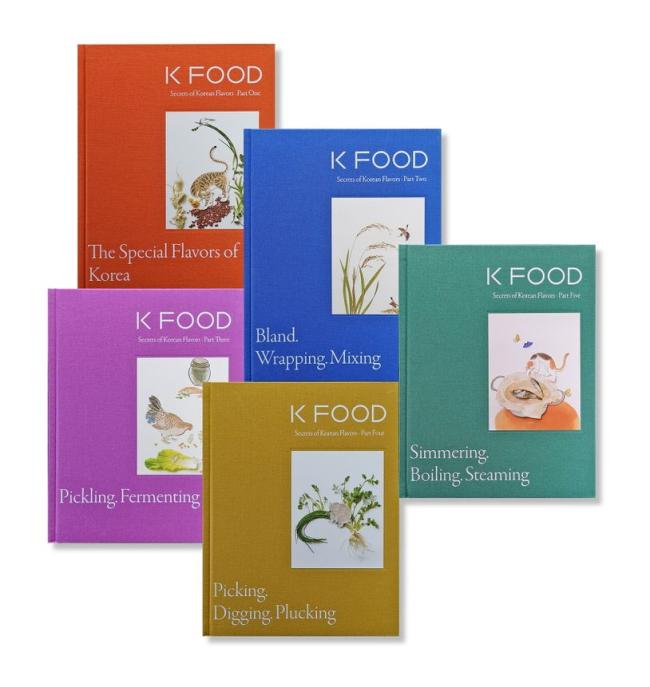
『K FOOD: Secrets of Korean Flavors』 is the result of an effort to examine the spirit and substance, and the past and the present, that has taken root in the Korean table, with a dense and bold eye. Above all, this book looks at Korean food in terms of cultural codes such, as 'flavorlessness,' 'fusion,' 'fermentation,' 'gathering,' and 'moist-heat' instead of traditional standards, such as 'season' and 'ingredients.' Korean food begins with a bland and mild ‘tasteless’ rice, and that rice is wrapped up in a ssam or mixed with meat and vegetable ingredients, sesame oil, and red pepper paste for ‘fusion’ properties, which are the first and second codes. While the Western cooking code consists of the confrontation between cooked and raw, and meat diet and vegetarianism, the third code examines the taste of fermented Korean food, that is, Korean food through ‘fermentation.’ The fourth code, ‘namul culture,’ looks into Korean food through the tradition of the ‘gathering era’ of digging for namul (greens), picking tree fruits, and plucking marine plants. The fifth code, ‘wet culture’, focuses on foods that are always included in Koreans' meals. They are broth-based foods such as soup, tang, stew, and hot pot, foods that need to be simmered, such as yeot (Korean taffy), grain syrup, and syrup, and foods cooked with steam, such as rice cakes and other steamed foods. Former Minister of Culture Lee O-young, “Korea’s best scholar,” took on the task of coding through this insight into the spirit and matter, and the past and the present of Korean food. Han Bokryeo, the director of the Institute of Korean Royal Cuisine, Chung Haekyung, Professor in the Department of Food and Nutrition at Hoseo University, Park Chaelin, Ph.D. at the World Institute of Kimchi, and Cha Gyunghee, Professor of Korean Cuisine at Jeonju University, were responsible for the task of specifying and presenting the code in detail across each volume.
The two-year-long journey bundled into five volumes originated from the idea that food, especially Korean food, is not just a material substance that fills the stomach but somewhat of a 'media' with strong communication powers. This is the result of a comprehensive examination from the roots of Korean food such as royal cuisine, temple food, and Jongga food, to the scenery of the dining table where Koreans live in 2021, and from the source of ingredients to producers, from representative local foods to popular products on the market.
Korean food, which is prepared by mixing, fermenting, seasoning, and boiling, harmonizes with the principles of circulation and paradox. They do not ‘exclude’ but ‘include,’ and embrace and harmonize with each other. It not only adheres to the memories of the past or the taste of tradition, but also fuses and develops with the present taste and foreign culture, and as this book struggled to find this, it would be very reasonable to name this book ‘K-food,’ like ‘K-pop,’ ‘K-drama,’ and ‘K-beauty.’
A cookbook co-created by the ‘Korean Food Avengers’
『K FOOD: Secrets of Korean Flavors』 consists of the ‘Food Humanities’ section at the beginning of each book which unravels Korean food by code. At the back of each volume, according to the code, there are ‘everyday Korean recipes’ that Koreans enjoy these days. A total of 158 recipes were recorded in detail, from the selection of ingredients to recipes: 33 everyday Korean food made by wrapping and mixing, 54 recipes of everyday Korean food made by pickling and fermenting, 36 recipes of everyday Korean food prepared by digging, pickling and plucking, and 35 recipes of everyday Korean food made by boiling, simmering and steaming. Korean food chef Cho Heesuk (2 volumes), Lee Hayeon (3 volumes), the Kimchi Association of Korea’s president and Food Master designated by the Ministry of Agriculture, Food and Rural Affairs (3 volumes), Korean food chef Roh Younghee (4 volumes), and Han Bokryeo (5 volumes), a master of royal cuisine of the Joseon Dynasty, participated in this work. It can be said that it is a work in which the ‘Korean Avengers’ participated. As a result, Korean recipes that started from the authenticity that captured the present and daily life were completed. This cookbook, 『K FOOD: Secrets of Korean Flavors』 has the attitude of seeking truth from facts.
Book Introduction - Description of Each Volume
〈K FOOD: Secrets of Korean Flavors: Part 1, The Special Flavors of Korea〉
This is a general overview that outlines Korean food with the codes of 'flavorlessness ', 'fusion', 'fermentation', 'gathering,' and 'moist-heat.' In addition, we explored the special tastes of Korea, such as royal cuisine, Jongga food, Banga (nobleman house) food, temple food, seasonal holiday food, and rite of passage ceremonial food. It also contains basic information on ingredients that Koreans enjoy these days, Korean seasoning and garnish, Korean cooking tools, Korean dishes, such as white porcelain, brassware, Onggi, Korean ethnic earthenware, and woodenware, etc., and dining table and soban (a small portable dining table).
〈 K FOOD: Secrets of Korean Flavors: Part 2, Bland, Wrapping, Mixing〉
The basic composition of Korean food is rice, to the extent that all food except rice is considered a side dish to accompany rice. The bland and mild rice differentiates the taste of all kinds of side dishes and fuses them simultaneously. We explored the secrets of fusion culture, such as 'ssambap' and 'gimbap,' where you put together all kinds of ingredients and put them in your mouth, and 'bibimbap,' which is eaten by mixing various ingredients. It also includes recipes of everyday dishes that are eaten wrapped and mixed.
〈 K FOOD: Secrets of Korean Flavors: Part 3, Pickling, Fermenting〉
Like kimchi and sauces, the characteristic of Korean food is the taste of fermented food, neither raw nor cooked. We looked at ingredients for making soybean paste, soy sauce, red pepper paste, kimchi, fermented liquor, etc., and explored tools necessary for fermentation, such as earthenware and jangdokdae, a platform for traditional earthen jars. It also includes recipes for fermented foods that Koreans enjoy in their daily life.
〈K FOOD: Secrets of Korean Flavors: Part 4, Pickling, Digging, Plucking〉
Koreans dig up, pick, and pluck almost all parts of plants, like mountain herbs, wild vegetables, and garden vegetables, to make them a meal. The culture of enjoying marine plants such as seaweed and laver, and the culture of collecting and enjoying root plants and tree fruits are also old traditions. It examines the gathering culture of Koreans, which can be called the 'namul nation,' and includes everyday recipes.
〈K FOOD: Secrets of Korean Flavors: Part 5, Simmering, Boiling, Steaming〉
One of the most important codes for interpreting Korean food is the \"wet culture,\" a mixed system of eating solid ingredients and broth together. Soup food represented by broth, such as soup, stew, and hotpot, and noodles, such as noodle soup and ramen, and foods that steam for a long time, such as rice cake and steamed foods were examined.















 \r\n - 저자: 행복이가득한집편집부지', 'https://minibandi.com/m/product/detailProduct.do?prodId=4777027', 'https://image.bandinlunis.com/upload/product/4777/4777027.jpg');)
 \r\n 저자 : 행복이가득한집편집부지', '[반디앤루니스] K FOOD : Secrets of Korean Flavors 영문판 (양장)', 'Five Codes to Examine Korean F', 'https://image.bandinlunis.com/upload/product/4777/4777027.jpg');)